
Food certifications are often treated as a compliance checkbox rather than a strategic commercial asset. For businesses sourcing coconut products, this is a missed opportunity. Halal, Kosher, and Vegan certifications each open the door to specific consumer segments and distribution channels that would otherwise be inaccessible, and they also carry credibility signals that influence purchasing decisions across a broader audience beyond the strictly observant or committed.
Understanding what each certification involves and why it matters commercially is increasingly important for any importer, manufacturer, or private label brand operating in global food markets.
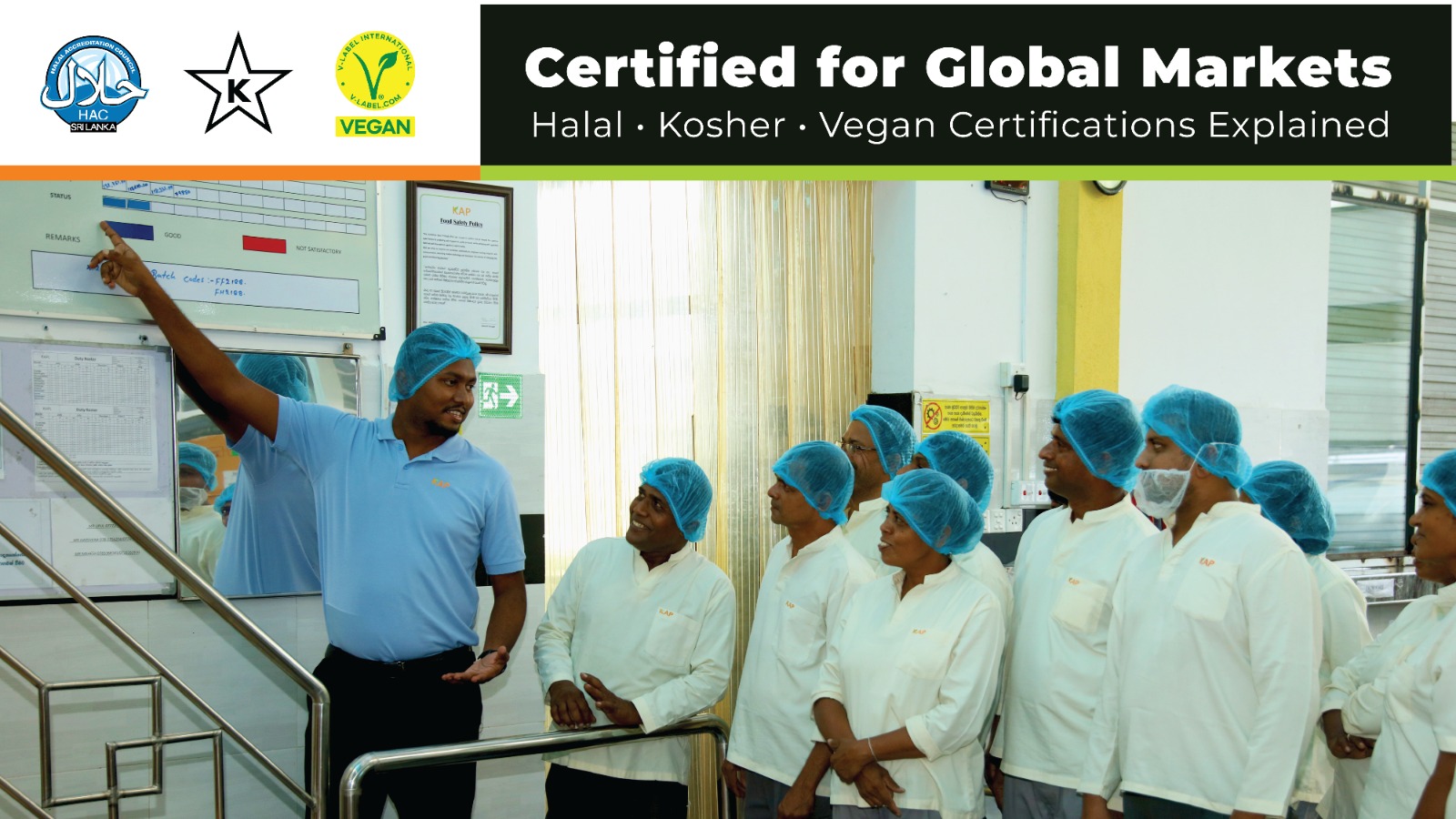
Halal Certification and the Scale of the Opportunity
The global Muslim population exceeds 1.8 billion people, and a significant proportion of them actively seek out Halal-certified food products. In markets like the Middle East, South-East Asia, and increasingly the UK and Europe, Halal certification is not a niche requirement but a basic expectation for a large and growing consumer base.
For coconut products specifically, Halal certification means that the entire production process, from raw material sourcing through to packaging, has been assessed and verified as compliant with Islamic dietary law. This involves ensuring that no prohibited substances have been used at any stage, that equipment is cleaned and maintained in an approved manner, and that the certification body has ongoing access to audit the facility. For buyers supplying Halal retail channels or food service operators in Muslim-majority markets, sourcing from a Halal-certified manufacturer is a non-negotiable baseline.
Why Kosher Matters Beyond Jewish Communities
Kosher certification is often associated primarily with the Jewish market, but its commercial relevance extends considerably further. Many food manufacturers source Kosher-certified ingredients specifically because the Kosher certification process involves rigorous oversight that provides additional assurance about ingredient sourcing, production cleanliness, and the absence of certain contaminants.
In the United States, Kosher-certified products are widely available in mainstream supermarkets and purchased regularly by consumers who are not Jewish but who view the certification as an indicator of quality and careful production. Some food processors also use Kosher-certified coconut ingredients to simplify their own compliance processes for customers who require Kosher finished products.
Vegan Certification and the Plant-Based Movement
Vegan certification guarantees that a product contains no ingredients derived from animals and has not been tested on animals. For coconut products, which are inherently plant-based, vegan certification might seem redundant. In practice, however, the certification provides important assurance that the production process itself has not introduced any animal-derived substances at any stage.
Some processing aids, stabilisers, and fining agents used in food production are derived from animals, and without certified vegan status, consumers and manufacturers who need to make a definitive claim about their products cannot be certain these have not been used. Vegan certification removes any ambiguity and allows downstream manufacturers to make credible vegan claims on their finished products.
The market for vegan-labelled products has grown significantly across Europe and North America, driven by consumers who identify as vegan as well as a much larger group who are simply reducing their consumption of animal-derived products and looking for options that align with that intention.
The Commercial Logic of Multiple Certifications
A manufacturer who holds Halal, Kosher, and Vegan certification simultaneously offers something genuinely useful to buyers who supply diverse markets. Rather than maintaining separate supply chains for different certification requirements, you can source from a single certified manufacturer and serve multiple consumer segments with the same underlying product.
This matters particularly for private label operators and distributors who serve multiple retail channels across different geographies. A single SKU of Halal, Kosher, and Vegan certified organic coconut milk from a BRCGS AA manufacturer is a remarkably versatile product that can be sold through Islamic retail channels, health food stores, mainstream supermarkets, and online health and wellness platforms simultaneously.
What to Verify When Evaluating Certified Suppliers
Certifications are only as credible as the certification bodies that issue them and the rigour with which they are maintained. When evaluating a supplier who claims to hold Halal, Kosher, or Vegan certification, always request copies of the actual certificates and check that they are current rather than expired. Verify the issuing body and confirm that it is recognised in the markets where you intend to sell.
Also confirm that the specific products you intend to source are covered by the certification, not just the facility in general. Some manufacturers hold facility-level certifications that apply to all products, while others have product-specific certification coverage. Understanding the scope of the certification is important before you make claims on your own packaging or marketing materials.
Building Your Own Certification Story
Beyond the immediate commercial benefits, sourcing from multiply certified manufacturers allows you to build a richer and more credible story around your own brand. In a market where consumers are increasingly interested in the ethics, safety, and origins of their food, being able to point to a supply chain partner with Halal, Kosher, Vegan, Organic, and Fairtrade certification gives you a depth of provenance narrative that competitors sourcing from less rigorous suppliers simply cannot match.
Certifications earned by your manufacturer do not automatically transfer to your brand, but they provide the raw material for a compelling and verifiable story about where your products come from and how they are made. That kind of transparency is increasingly valued by both retailers and consumers, and it is worth building into your sourcing strategy from the start.
